BSU Accreditation
Accreditation is one of the key processes that ensure quality of education and its continuous improvement in the TLIs (Tertiary Level Institutions) of the Republic of Armenia. It allows to periodically evaluate the effectiveness of the TLI activities, as well as assess whether the institution performs its Mission and responds to the requirements of the State and the public. Additionally, accreditation helps to identify the TLI strengths and weaknesses, target the accumulated experience and improve the internal quality assurance (IQA) mechanisms.
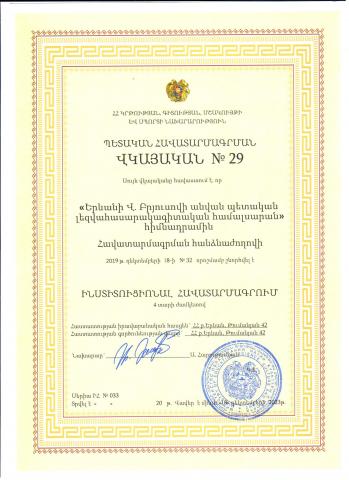
BSU has undergone a process of accreditation and has been granted institutional accreditation by Article 11 of the RA Government Decision N 978, dated June 30, 2011, and by Decision N 9, dated April 11, 2015, of the Accreditation Committee of the National Center for Professional Education Quality Assurance Foundation (ANQA).
BSU Internal Quality Assurance system was externally evaluated by international experts in the reporting period. In October 2016, BSU Center for Quality Assurance and Reforms coordinated the activities of BSU working group on Tempus GOVERN program, carrying out self-analysis based on the ASIIN format for 3 criteria outlined below and presenting it to the head team of Tempus GOVERN program: (1) strategic planning, (2) HR management, (3) quality management.
The experts had meetings with the University management, QARC staff, academic staff and students. After the visit the experts provided the assessment results.
In 2018-2019 the 2nd institutional accreditation process was carried out at BSU. As a result, BSU was awarded with institutional accreditation for 4 years. Afterwards BSU presented to the ANQA the improvement plan for the elimination of shortcomings mentioned in the expert report, which is aimed at improving the current problems and strategic development of the university.
In 2023-2024 the 3rd institutional accreditation process was carried out at BSU. At the end of the year, by the Accreditation Committee decision as of 26.12.2023, BSU was awarded with the institutional accreditation for 4 years for the third time. BSU continues to carry out the activities towards improvement, based on its strategic priorities as well as on the BSU plan on elimination of shortcomings specified in the expert panel report.
What is Institutional Accreditation?
Institutional (infrastructural) accreditation is the recognition of compliance of the educational and quality assurance processes, as well as academic programs of the educational institution with the state academic standards, the RA NQF descriptors and the infrastructural accreditation standards by the State. Institutional accreditation is granted for a specified period of time, certifying that educational institutions or academic programs have the necessary capacity to perform quality educational activities within the given period. It is a mandatory process for all TLIs (Tertiary Level Institutions) to be implemented periodically. This process allows to periodically evaluate the effectiveness of the TLI activities, as well as to monitor whether it is fulfilling its mission.
Accreditation Procedure
According to the first subpoint of Article 8 of the RA Government Decision N 978, dated June 30, 2011, institutional and program accreditation processes shall be implemented in three successive stages:
Stage 1: TLI Self-Assessment. At this stage, the institutins being accredited study their mission, goals, processes and achievements through a detailed self-analysis process.
Stage 2: External evaluation by an independent expert group. The main purpose of the expert visit is to ascertain the authenticity of the facts and information included in the self-analysis, to obtain additional information through meetings and inquiries, to study educational processes and additional documents to better understand the activities of the institution under examination. That is, experts carry out expert analysis, after which evidence of achievements and consultation are provided to further improve the works of the institution.
Stage 3: Preparation of final expert report and decision-making by the National Quality Assurance Center (ANQA) Accreditation Board /www.anqa.am/.