Chair of Public Communication and Journalism
Chair of Public Communication and Journalism has been operating since 2004. It was originally established as an educational center for “International Journalism” within the UNESCO Chair of Human Rights, Democracy and European Studies. Since 2009, it has been functioning as an independent structural division of the university. In 2017, it was renamed the Scientific-Education Center for Journalism. In 2023 the scientific-educational centers for Journalism and Public Communication Technologies (the latest was operating as a separate center from 2011 to 2023) were merged into one unit – the Scientific-Educational Center for Public Communication and Journalism. In September 2025 the Center was restructured as a Chair of Public Communication and Journalism.
The Chair is currently preparing specialists in the fields of journalism and public communication with the knowledge of foreign languages. The Chair is operating in the Department of Public Communication and Service and offers the following undergraduate and graduate programmes: “Journalism” & “Public Relations” (the mode of study is both full-time and part-time).
Throughout the years of existence, the Chair has preserved the old traditions. However, it considers the current developments, as well as the trends and best practice of the world leading higher education institutions that provide quality education and teaching in the fields of journalism and public communication.
The education is conducted in close cooperation with the leading media corporations and other partner organizations in the RA.
Students get not only the knowledge and skills required for the future professional development but also master several foreign languages which is of great demand by the labour-market.
Our graduates can build their career in the leading media and state organizations, and in the private companies. They become qualified specialists who are compatible in television and radio journalism, multimedia and other fields of communication. They can work as PR managers, press secretaries in the public and private organizations, officers or heads of the department for the public relations and information, information security specialists, marketing managers, brand managers, etc.
Career Opportunities
Our students have possibilities to continue their career in a range of public and private organizations, including:
- Department for Information and Public Relations in the RA Government
- Department for Public and Information Relations in the National Assembly of RA
- Respective departments in different ministries
- Media organizations
- Journalism organizations
- Large, medium-sized and small business, production, commercial and service organizations
- Private corporations in the fields of public relations, marketing, advertising
MISSION
Our mission is to foster the development of the media in the RA through ensuring a competitive education and quality research output.
Goals
Our goals are:
- to prepare competitive specialists in the fields journalism, information and public communication in line with the current needs,
- to offer a quality professional education in the fields of journalism, public relations and other communication technologies,
- to develop and apply the teaching and learning methods that can promote the professional development and prepare specialists ready to respond to the ever-changing media environment and communication technologies,
- to promote innovations and research to ensure developments in journalism, public relations and media communication,
- to enhance the management system strengthening links between the structure of the center, its activities, the resources and the strategic priorities,
- to promote the development of public communication and information in the RA through providing quality and competitive education,
- to enlarge research in the journalism and public relations in the RA.
Objectives
The objectives of the Chair are:
- to ensure the academic programmes are up-to-date and are addressed to the current professional needs and demands of the market through considering the potential of the university and responding to the external factors,
- to establish an educational environment that can create linkage between the academic process and the active media organizations in the country,
- to consider the innovative teaching and learning methods while developing the academic programmes and curricula,
- to ensure the learning outcomes of the academic programs clearly define the knowledge, skills and competences as well as professional values of the graduates,
- to ensure modernization of the resources and equipment for the Chair aligning it to the programme needs,
- to enlarge interdisciplinary and research collaboration with other departments of BSU, other HEIs and stakeholders,
- to strengthen cooperation between the alumni, market representatives and staff, students, faculty with the aim to improve teaching and learning, ensure the professional development and innovations,
- to adapt the innovative teaching and learning methods, services, technologies making them aligned with the programme goals and objectives. That will help to revise and redevelop the learning outcomes.
- to strengthen the potential of the Chair through uniting the alumni and other stakeholders to ensure the effective implementation of the Center’s vision, mission and goals,
- to develop a comprehensive management model and support services promoting cooperation, transparency and effectiveness,
- to engage professional specialists of the field through ensuring the recruitment, professional development and maintenance of the qualified faculty and staff,
- to ensure smooth and transparent enrollment and maintenance of the students.
Activities
The activities of the Chair include but are not limited to:
- promote the research potential in the field of communication,
- ensure continuous development and revision of the academic programmes,
- foster the integration of the courses in the journalism, information and public communication technologies in the European agenda and raise the awareness among the staff and faculty,
- provide consultancy and extra-curricula activities to the students on the current challenges and issues with regards to journalism, information and public communication in the RA and at international level,
- promote the development of the collaboration between departments of BSU and other educational and scientific organizations in the RA and worldwide,
- coordinate the activities with the students, faculty and the staff,
- develop and publish textbooks, manuals, guides, booklets and guidelines,
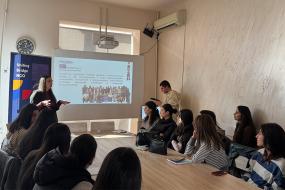
- arrange scientific-educational events, like seminars, discussions, conferences, master classes, exhibitions, etc.
- cooperate with the educational institutions in the RA and worldwide,
- organize practical courses in the leading media organizations, to watch movies, to conduct discussions and other activities for BSU students,
- conduct scientific research activities addressing the current issues in journalism and public communication,
- organize scientific-educational events,
- organize and hold seminars, round-table discussions, conferences, training and short courses.